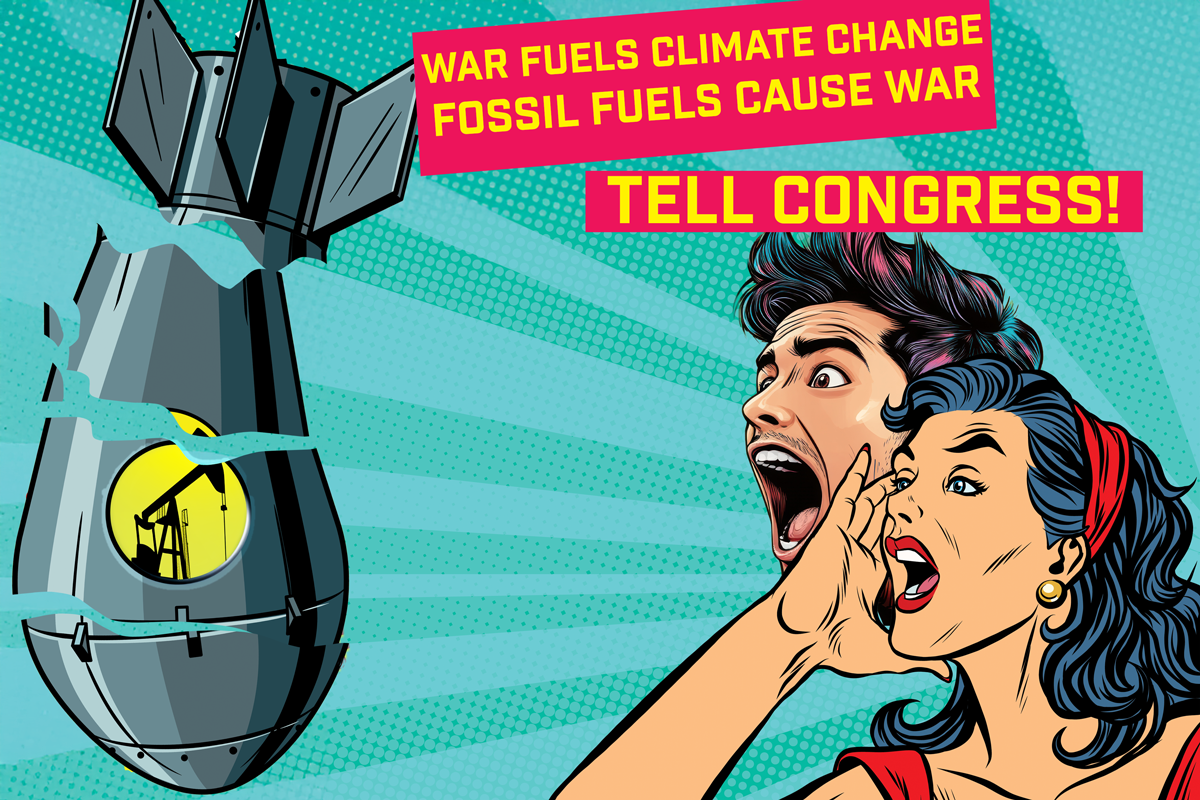
Dec 22 update — Congress voted to pass a National Defense Authorization Act (NDAA) that adds $8 billion to Trump’s already obscenely high military budget – and Trump signed the law earlier this week. That would be bad enough, but Trump has all but declared war on Venezuela this week, seizing two oil tankers and chasing a third and summoning air national guard units from as far away as Vermont to the Caribbean to prepare for an assault or bombing campaign.
None of this is normal. None of this is legal. But it does demonstrate why BXE and our allies launched a new campaign this fall to address the significant and toxic connection between war, militarism, and fossil fuels. This is a clear-cut example of the connection between war/militarism and fossil fuels.
More than 10,000 copies of our war and climate disruption statement have already been sent to Congress. We plan to deliver another copy of the letter signed by organizations to Congressional leaders on January 5, the first day they return to DC. You can take action with us this week by:
- Work with an organization or group? Sign on to our coalition letter here.
- Call (202) 456-1111 or email the White House at president@whitehouse.gov and tell Trump the American people do not want him to go to war with Venezuela.
- Attend a local “No war with Venezuela” demonstration in your town this week, there are marches and rallies planned in DC, Baltimore, New York, and other major cities.
- Send an email (or send another) to your Representative and Senators asking them to cut military spending, invest in our climate and communities, and reduce the US Military’s use of fossil fuels.
Our original post from December 9 is below if you need a reminder or want to forward to a friend.
For years, we’ve worked to connect the dots between climate change, the military, militarism and violence more generally, and fossil fuels. And we just heard that Congress could vote as soon as this week on a new National Defense Authorization Act (NDAA), an annual ‘must pass’ spending bill for the US military industrial complex. The legislation Congress is considering would add $8 billion to Trump’s already obscenely high military budget.
That’s why a few weeks ago we joined our old allies at BXE to launch a new campaign this holiday season to address the significant and toxic connection between war, militarism, and fossil fuels. Now is the time to deliver our message to Congress before this important vote.
Work with a group or organization? You can read our organizational letter to Congress here and sign on here – it has the same demands but is designed for groups instead of individuals.
Here’s why we’re working on this now: The US military is already the world’s largest institutional consumer of fossil fuels and contributor to global climate change. In addition, all militaries around the world are exempt from the emissions reduction goals of the Paris climate agreement. And those costs and impacts are not evenly distributed. Countries in the global north spend 30 times (3000%!) more on their militaries than on climate action and environmental protection. And they are led by the United States which spends more than $1 trillion each year on its military, more than the next seven largest military budgets in the world, combined.
But it is not simply the existence of a fossil-fueled military industrial complex that concerns us. We see clearly that fossil fuel use in this age of climate disruption leads directly to war and militarized conflict, and vice versa. And we know that specific areas of conflict and war are at this very moment being fueled by the greed of corporations and governments to extract and burn fossil fuels:
- The first US gulf war in 1991 emitted 131 million tons of global warming pollution and was widely decried as a war for oil — something even US officials admitted at the time.
- The conflict between Russia and Ukraine began with disputes over shipments of fossil fuels to Europe, at times stoked or encouraged by the United States. But the war between the two countries has become a full blown climate and environmental disaster, emitting more than 230 million tons of global warming pollution as well as water, air, and chemical pollution Ukrainian activists have documented how Russia and other nations that rely on fossil fuel exports slide toward authoritarianism.
- Israel’s genocide in Gaza emitted more than 32 million tons of global warming pollution. And the discovery of major natural gas fields off the coast of Palestine were a driver of the conflict.
- And now comes the Trump administration, which has proposed the largest expansion of military spending and the biggest expansion in fossil fuel extraction and export in US history. The regime’s recent lawless attacks on various boats in the Caribbean and Pacific are only preamble to what appear to be plans for all out war with Venezuela – a conflict which they have already acknowledged centers on “seeking control of oil fields.”
These are only examples, but they paint a clear and concerning pattern: War fuels the climate crisis, while fossil fuels and climate disruption feed war. And Donald Trump is supercharging both, to the detriment of all people and communities around the world. That includes here in the US where people face militarized police, the deployment of military and national guard forces in our communities, rising energy prices and a cost of living crisis, and a cascade of climate fueled disasters from fires to floods. These negative impacts disproportionately impact frontline communities, including people of color, low-income households, and other vulnerable groups who are often already facing environmental injustices.
- Cut the Pentagon budget by roughly 10%, and re-allocate the funds to healthcare, education, housing and climate action. Continue with reductions as a US world peace initiative reduces armed conflicts internationally.
- End all US fossil fuel subsidies, valued at more than $190 billion over a 10 year period, and invest that money in peace and clean energy.
- Require the US military to publicly document and report its emissions to the UNFCC, and produce a plan to reduce them 50% by 2030, and to ‘net zero’ by 2050 – in line with other US climate commitments.
Together, we can fight war, stop climate change, and create a peaceful, clean future for all.
Pingback:This is a fossil fueled fascist war for oil - 198 methods
Pingback:2025 sucked, we have the charts and graphs to prove it - 198 methods